top



Reducing discrimination in the workplace is something most organisations are genuinely trying to do. The harder question — which interventions actually work, and why — has been more difficult to answer. Many studies of anti-discrimination programmes assess attitudes and behaviours that are not specific to work, which makes it difficult to draw conclusions that translate into practical guidance. Evidence has also been inconsistent: an intervention might reduce one aspect of bias while showing no effect on another, leaving organisations uncertain about what to invest in.
A recent meta-analysis by Elaine Costa, published in the Journal of Applied Psychology, addresses both problems. Drawing on 70 peer-reviewed studies and 208 separate effect sizes, Costa examines which types of intervention most effectively reduce workplace discrimination — and introduces a framework that helps explain why some approaches work better than others.
Bias, at its broadest, is an unfair evaluative, emotional, or behavioural response that favours or disadvantages a person on the basis of their group membership. One way of organising how bias works draws on the tripartite model of attitudes — a framework that describes attitudes toward others as having three distinct dimensions: cognitive (thoughts, beliefs, and ideas), affective (positive or negative emotional responses), and behavioural (overt actions and decisions).
When applied to intergroup attitudes, these three dimensions map to familiar concepts. The cognitive dimension corresponds to stereotypes — the socially learned mental schemas people hold about particular groups. The affective dimension corresponds to prejudice — the overall positive or negative feelings directed toward group members. The behavioural dimension corresponds to discrimination — the actions and decisions in which attitudinal bias is actually expressed.
These dimensions are related but distinct, and an intervention can shift one without necessarily shifting the others. Costa's framework uses this to explain something important: interventions produce stronger effects when the dimension they target matches the outcome being measured. For organisations focused on reducing workplace discrimination — the dimension that causes the most direct harm — that has clear implications for where to invest.
Costa organises active interventions into three categories, each mapped to a specific attitude dimension. Interventions that target the cognitive dimension she calls disrupting stereotype processing. Those targeting the affective dimension she calls updating affective states. Those targeting the behavioural dimension she calls inhibiting bias manifestation. A fourth category — educating about bias processes — takes a passive approach, raising awareness without directly targeting any specific dimension.
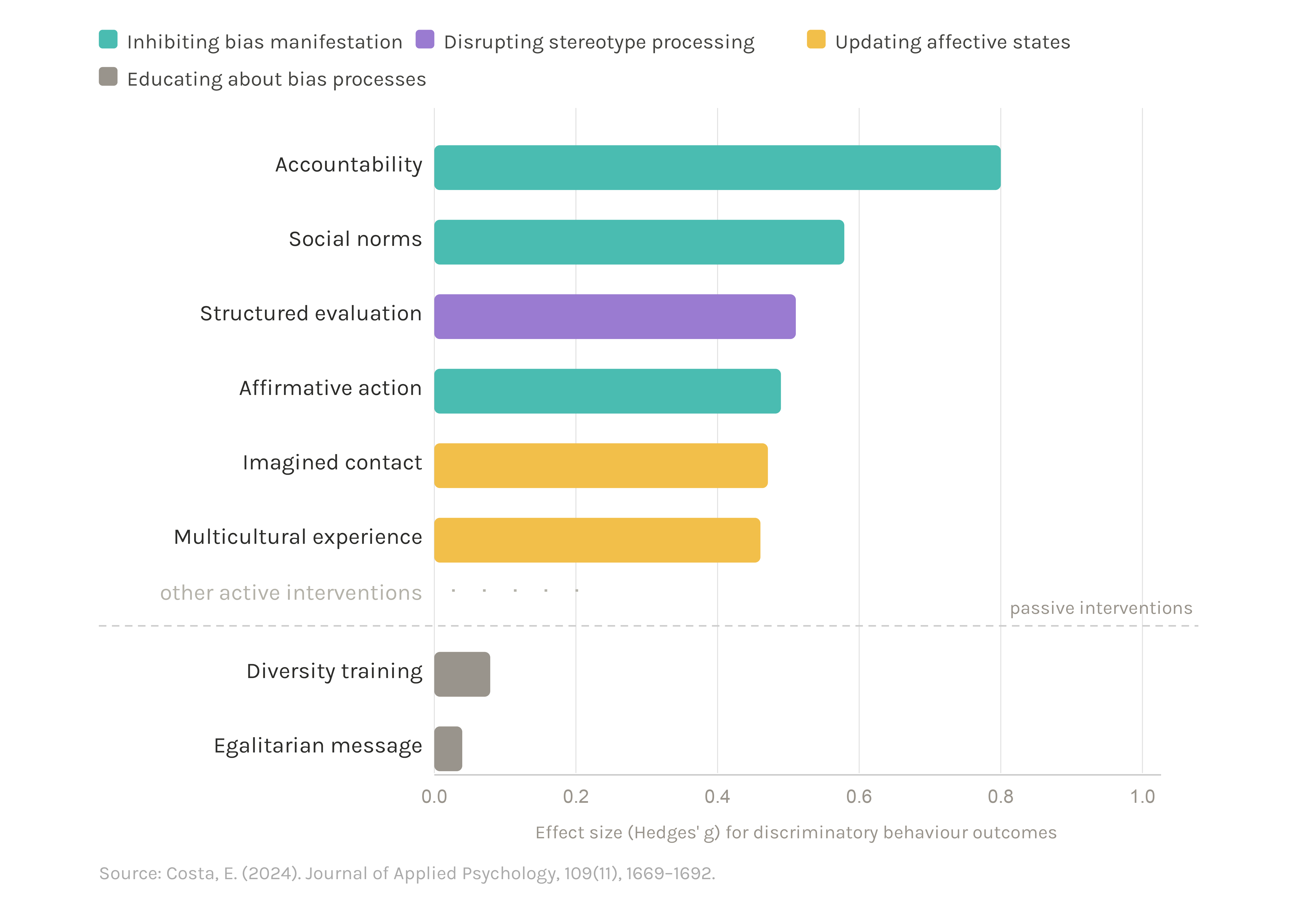
The chart above shows effect sizes for discriminatory behaviour outcomes across intervention types, based on Costa's meta-analysis of 70 peer-reviewed studies.
Interventions in this category target the behavioural dimension of bias directly. Rather than trying to change what evaluators think or feel, they create external incentives that discourage bias from being acted on. Costa found this category produced the strongest overall results for reducing discrimination — the dimension of bias that causes the most direct harm in hiring, promotion, and day-to-day working relationships.
Accountability is the most effective intervention type within this category. Accountability mechanisms require evaluators to explain or justify their ratings, decisions, and conclusions. When people know they will need to account for their choices, they are significantly less likely to act on stereotypes or biases.
In practice this means building justification into evaluation processes as standard. Hiring panels that document their reasoning. Promotion decisions that require written rationale. Pay review processes with structured sign-off. The intervention is in the process design, not in a training room.
Social norms interventions — disclosing information about the acceptable standard of conduct in a given context — also fall within this category and showed strong results. The mechanism is similar: behaviour is shaped by external incentives rather than by attempts to change underlying attitudes.
Interventions in this category target the cognitive dimension of bias — the stereotypes and heuristics that shape how evaluators process information about candidates and colleagues. The approach is to interrupt that processing before it influences a decision, rather than trying to change underlying beliefs directly.
Structured evaluation is the most effective intervention type within this category. The principle is straightforward: use consistent criteria and anchored rating scales across all candidates or employees being assessed. By reducing ambiguity in the evaluation process, structured evaluation removes the space in which stereotypes tend to operate.
CV anonymisation works on the same principle at an earlier stage — removing information that triggers stereotypic associations before an evaluator encounters it. The evidence on anonymisation is more mixed than for structured evaluation, however. It tends to show positive effects where discrimination is a significant issue, but can have neutral or negative effects in organisations already operating with a more pro-diversity approach, where it removes contextual information that would otherwise benefit candidates from underrepresented groups.
Structured evaluation is most valuable where assessment involves significant discretion — shortlisting, promotion panels, performance calibration. These are exactly the contexts where ambiguity is highest and the evidence suggests the intervention will have most effect.
Interventions in this category target the affective dimension of bias — the feelings and emotional responses that constitute prejudice. The goal is to foster more positive affect toward members of a target group before an evaluation takes place.
Imagined contact is the most effective intervention type within this category for reducing discriminatory behaviour, and on first encounter the least obviously credible. It asks evaluators to envision a positive interaction with a member of a target group before making an assessment. No training programme, no policy change, no structural redesign. The effect sizes are meaningful.
Perspective-taking exercises work on the same principle — asking evaluators to consider a situation from the point of view of a member of a target group before reaching a judgement. Both approaches are low-cost and can be built into evaluation processes without significant disruption.
It is worth being precise about why they work. The mechanism appears to operate through reduced intergroup anxiety and increased empathy — emotional rather than cognitive pathways. Notably, the alignment effect for affective interventions and affective outcomes was not statistically significant in Costa's analysis, which means the case for these interventions rests primarily on their demonstrated effect on discriminatory behaviour rather than on prejudice reduction specifically.
Passive interventions — equality messaging, diversity training, awareness-raising initiatives — occupy a different position in Costa's framework. Rather than targeting a specific dimension of bias directly, they provide information and raise awareness, relying on individuals to be motivated to update their own behaviour as a result.
Costa's analysis found these approaches produce smaller effects than active interventions across all outcome measures. That finding is worth being precise about. It does not mean awareness-raising has no value — it means its effects are limited when used as the primary or sole approach. Raising awareness of bias may be a reasonable starting point, or a useful complement to active interventions, but the evidence does not support treating it as sufficient on its own.
The practical implication follows from the alignment principle. Passive interventions do not target any specific dimension of bias, which means they are unlikely to produce strong effects on any specific outcome. Organisations whose DEI programmes rest primarily on awareness-raising are working with an intervention whose mechanism depends on individual motivation — and that is a fragile foundation for producing consistent behavioural change.
The table below summarises the four categories and the most effective intervention in each.
Costa's framework does not make DEI programme design straightforward — the organisational, cultural, and political factors that shape what is feasible remain as real as ever. What it does is give a clearer basis for the choices involved. Matching the intervention to the dimension of bias you are trying to shift, and combining active approaches rather than relying on any single one, is what the evidence supports.
For organisations reviewing their DEI investment, the most useful starting question is a simple one: what are we actually trying to change? The answer shapes everything that follows — which interventions to prioritise, how to combine them, and what meaningful evaluation looks like.
Let’s start a conversation about how employee surveys can help you develop a workplace where people and performance grow together.