top



This guide is written for HR Directors, CPOs, OD leads, and people analytics managers who are planning, reviewing, or reworking an employee survey programme. It covers the full lifecycle — choosing the right type of survey, planning, questionnaire design, running the survey, analysis, and acting on what you find — with a focus on the decisions that shape whether the programme produces change.
The choice of survey type is the first design decision, and it should follow directly from what the survey is trying to achieve. A survey designed to set an annual baseline, a survey designed to monitor a specific issue month-to-month, and a survey designed to capture employee experience at key points in a career do different jobs. Trying to do all three in one instrument rarely works well.
Five types cover what most organisations need.
Core surveys — sometimes called census, assessment, or baseline surveys — are designed to give a broad picture across many aspects of the employee experience. Typical themes include resources, psychological safety, wellbeing, autonomy, reward, recognition, learning and development, teamwork, communication, leadership, culture, and organisational commitment.
They are the natural choice for an organisation running its first employee survey, and for most organisations they remain the backbone of the programme once established. They involve all employees and are typically repeated annually.
The strength of a core survey is its breadth. Because it covers the main themes that influence how employees experience their work, it can surface issues the organisation did not know it had and provide the baseline against which every subsequent intervention can be measured. The limitation is length — covering that breadth means 30–50 questions, which is at the upper end of what most employees will complete thoughtfully. That limitation is why deep dives and pulses exist.
Pulse surveys — also called trend surveys — are shorter, more frequent check-ins that run between or alongside core surveys. They serve two related purposes: tracking whether an issue identified in a previous core survey is shifting in response to action, and picking up early signals of change in engagement before the next core survey.
A good pulse survey has a narrow focus. Five to fifteen questions targeted at the specific issues being monitored will produce useful trend data without fatiguing employees. What a pulse survey is not designed to do is replace a core survey — running frequent short surveys covering every theme at a fraction of the depth tends to produce noisy data and no clear action.
The question of cadence matters. Some providers promote weekly pulse programmes as a continuous listening strategy. In practice, few organisations can generate enough meaningful action in a week to justify asking their employees for feedback every seven days — and when action does not follow, the surveys themselves become the problem. Quarterly or monthly is the cadence that tends to work for most programmes.
Deep dives are targeted surveys that examine a single topic in more detail than a core survey can. They are usually prompted by a finding from a previous core survey — a score that needs more context, a theme that needs unpacking, or a group whose experience warrants closer investigation.
Because deep dives are narrowly focused, they can afford to ask more searching questions than a core survey — longer scenarios, multiple items on a single topic, open-text follow-ups. They are typically one-off rather than part of a repeating cadence, and they often involve a specific group (one function, one location, one grade, recent joiners) rather than the whole organisation.
A useful rule of thumb: if a finding from a core survey raised more questions than it answered, a deep dive is usually the right next step — and often a more productive investment than simply repeating the core survey with more items added to it.
Lifecycle surveys — also called experience surveys — capture feedback at specific moments in an employee's tenure. Typical trigger points include recruitment, onboarding, work anniversary, role change, return from parental leave, return from long-term absence, and exit.
Unlike core and pulse surveys, lifecycle surveys run continuously. Invitations are triggered by events rather than scheduled dates, meaning the survey is always open and always producing data. Each individual survey is short and role-specific — an onboarding survey asks different questions of someone in their first ninety days than a three-year anniversary survey asks of an established employee.
Lifecycle surveys complement the core programme rather than replace it. Their strength is capturing experience while it is still fresh and acting on it quickly — a new joiner's feedback is more useful in their first month than months later in an annual survey. Their limitation is that by definition they only measure experience at the triggering moment, which means they cannot substitute for the broader organisation-wide picture a core survey provides.
Preference surveys sit slightly outside the engagement-survey tradition. Rather than measuring how employees feel, they gather information about specific choices — which benefits they value most, which flexible working arrangements they would use, which training formats they prefer.
They are typically short, focused on a specific decision, and timed to support it — a benefits review, a hybrid working policy refresh, a learning strategy rewrite. Sometimes a preference section is folded into a core survey, but a standalone survey is usually cleaner when the decision is significant enough to warrant it.
The common mistake with preference surveys is to confuse them with engagement measurement. Knowing that 60% of employees would prefer a particular benefits option tells you nothing about how engaged they are, and a preference score cannot be treated as a driver of anything in the engagement sense. They are a different tool for a different job.
Most organisations running mature survey programmes use more than one type. A common pattern is an annual core survey, two or three pulse surveys through the year focused on issues the core survey identified, and a continuous lifecycle programme running underneath. Deep dives are added where a specific question warrants it.
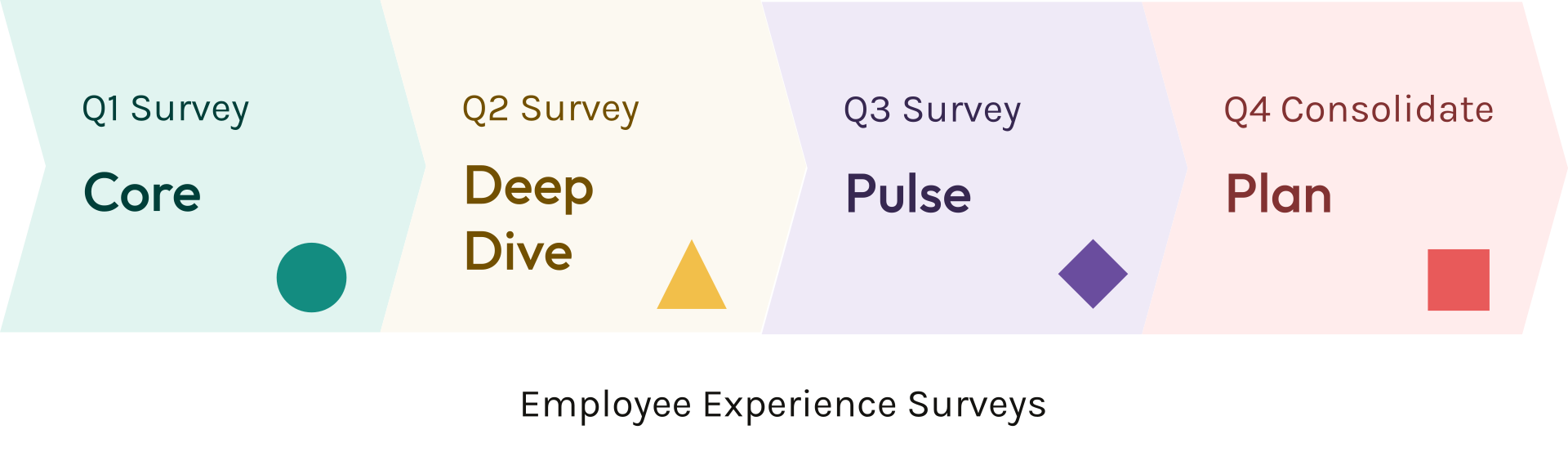
This is not the only workable pattern. An annual core survey on its own works well for some organisations — particularly those where the action-planning cycle genuinely takes the full year to land — and adding a pulse layer before the action from the last survey has taken effect can dilute rather than strengthen the programme. More is not always better.
What determines whether a multi-survey programme works is almost never the number of surveys. It is whether each one has a clear purpose, a defined audience, and a planned response. A programme that runs three surveys a year with intent tends to produce better outcomes than one that runs five without.
Survey fatigue is almost always misdiagnosed. It is routinely attributed to survey frequency — employees are being asked too often — and the fix proposed is to ask less often.
The more accurate diagnosis is that surveys without visible action lose credibility quickly, and employees stop answering honestly because they have learned it does not make a difference. The frequency is a symptom, not the cause. An organisation that runs one survey a year and does nothing with it will produce fatigue just as reliably as one that runs four.
The practical implication is that the resource question that matters when scoping a programme is not how many surveys to run but whether the organisation has the capacity to respond to each one with visible, specific action before the next one launches. A minimum cycle of three months between a survey closing and the next survey opening tends to be the shortest interval in which meaningful action and communication can actually happen.
For lifecycle surveys this looks slightly different — the same individual is not being re-surveyed, but the credibility of the programme still depends on action being taken on what the surveys reveal. A new joiner survey that identifies consistent onboarding problems across cohorts needs to produce change, or the next intake of new joiners will respond with the weary disengagement their predecessors learned to apply to the core survey.
The planning stage is where most survey programmes are won or lost. By the time a questionnaire is being drafted, the big decisions have already been made — what the survey is for, who it is talking to, when it will run, and what will happen afterwards. Getting these right turns a survey into a piece of organisational evidence. Getting them wrong produces data that nobody trusts or uses.
The first planning question is what the survey is actually for. Survey objectives fall into two broad camps.
The first is specific: the survey exists to inform a particular decision or track progress on a known issue. Examples would be evaluating a new hybrid working policy, tracking whether manager effectiveness has improved since a targeted training programme, or testing the appetite for a planned benefits change. These surveys have clear success criteria — the data either supports a decision or it does not.
The second is general: the survey exists to surface what is happening across the organisation that leadership may not currently see. A first-time core survey usually falls into this category. So does a post-merger survey run twelve months into integration, or a culture review prompted by a change in leadership. These surveys are genuinely exploratory, and the success criterion is that they produce a clearer picture than the organisation had before.
Both kinds are legitimate. The mistake is to blur them — to launch a survey with a vague sense of wanting feedback and no clarity about what it is for. The objective should be specific enough that someone reading the survey report six months later can tell whether it achieved what it set out to do. In most cases the objective will tie to something the business is trying to achieve — improving retention, supporting a strategic change, addressing a known engagement or wellbeing concern. In some cases it will not tie to a business outcome directly, and that is fine. What is not fine is the objective being left implicit.
A survey without a visible executive sponsor rarely produces meaningful action. The reason is practical rather than political: the actions that follow a survey almost always require decisions that sit above the HR function — resourcing, prioritisation, organisational changes, sometimes direct accountability for leaders whose results look weaker than they expected. Those decisions happen when a senior leader owns the survey and its consequences.
Sponsorship means more than a name on the launch email. It means the sponsor has been involved in defining the objective, will be present when results are reviewed, and is committed to owning the response. Where that ownership is absent, the survey will produce a report that sits on a shared drive and nothing will change — regardless of how good the data is.
This is worth testing honestly before a survey is commissioned. If the question "who in the executive team owns the response to this survey?" does not have a clear answer, the planning is incomplete.
Who is invited to take part is a design decision, not a default. For a core survey the answer is usually everyone, but there are reasons to narrow it — a recent acquisition still being integrated, a group going through a specific organisational change that would distort aggregate results, a population where a different instrument makes more sense.
For other survey types the scope follows the objective. A deep dive examining engagement in one function involves that function. A lifecycle survey is triggered by events and only ever reaches the individuals at the relevant point. A preference survey informing a specific decision reaches the group affected by it.
Two related points worth being explicit about at the planning stage. First, which employee groups will be reported on. The demographic cuts that matter for analysis — function, level, tenure, location, line manager, protected characteristics — need to be decided up front, because they determine both the demographic data collected and the sample sizes required for subgroup reporting. A survey planned without this discussion often produces data that cannot answer the questions leadership will ask of it. Second, minimum group sizes for reporting should be agreed before the survey launches. Most organisations set this somewhere between five and ten respondents — low enough to produce useful subgroup data, high enough to protect individual confidentiality. Communicating the threshold openly before launch is part of building trust in the process.
When a survey runs matters more than most planning conversations give it credit for. A survey launched during a reorganisation, immediately after a redundancy round, or during a major system implementation will produce data heavily coloured by the event — which is useful if the event is what the survey is designed to measure, and misleading if it is not.
The practical discipline is to map the organisation's year before picking a survey window. Financial year-end, performance review cycles, major strategic announcements, peak operational periods, planned leadership transitions — all of these affect either the response rate or the interpretation of results. A survey that consistently runs in the same window each year also produces cleaner year-on-year comparisons, because the contextual noise is held broadly constant.
One related point: the window between the survey closing and results being shared is where programmes often lose momentum. Three weeks from close to leadership review, and six weeks to full cascade, is a reasonable working target. Longer than that and employees reasonably conclude the organisation is not treating the data as urgent.
A short period of consultation before the survey is finalised tends to strengthen it. The purpose is not to design the survey by committee but to test whether the planned survey will address the questions that matter — and occasionally to discover that a survey is not the right tool at all.
Useful consultation conversations include a small number of employee focus groups across different functions and levels, one-to-one conversations with people managers who will run team results sessions afterwards, and short conversations with the executive sponsor and senior leadership team about what they most want to understand. The output is a clearer view of whether the objective is framed correctly, whether the planned themes are the right ones, and whether there are live issues the survey needs to address or deliberately avoid.
Consultation at this stage is separate from — and complementary to — the more specific question and theme testing that happens during questionnaire design. It sits at the level of "is this survey going to be useful?" rather than "is this question going to work?"
The single most important planning decision is whether the organisation has the capacity to respond to what the survey will reveal. Resourcing the response means people, time, and senior attention — the action planning sessions, the manager team conversations, the specific follow-through, the visible communication afterwards. It is the most commonly skipped planning decision and the one most responsible for surveys that fail to produce change.
A practical test: before commissioning a survey, write down what will happen in the three months after results are shared. Who is running which conversations. Who is accountable for which actions. How progress will be communicated. If those answers are unclear at planning stage, they will be unclear after the data arrives too — and the survey will produce a credibility problem rather than an organisational improvement.
This is not a separate credibility argument to the one made about survey fatigue in the previous section. It is the same point, seen from the planning end rather than the programme end. A survey that the organisation cannot resource to respond to is a survey that should be postponed until it can.
Resourcing is also a question of expertise, not only capacity. Some organisations have the in-house skills to design a questionnaire, analyse the results and report them safely; others are better served bringing in external survey expertise for some or all of that.
The questionnaire is where planning meets measurement. A well-planned survey with a poorly designed questionnaire will produce data that nobody trusts. A less rigorous plan can be partially rescued by a strong questionnaire. The hours spent on question design are usually the highest-return hours of the whole survey process.
Four things matter at this stage: identifying the right themes, writing or sourcing questions that measure those themes well, choosing a response scale that fits the programme, and keeping the whole thing to a sensible length. Piloting pulls it all together before launch.
Themes are the topics the survey will measure — the groups of questions that together assess an aspect of the employee experience. A typical core survey covers six to ten themes such as leadership, manager effectiveness, culture, development, reward, wellbeing, and teamwork.
The most important distinction at this stage is between four types of item: outcome, driver, awareness, and contextual. Keeping them separate in the design is the foundation for everything that happens in analysis.
Outcome items measure the thing the survey is trying to explain. In most core engagement surveys this is employee engagement itself — sometimes operationalised as work engagement (vigour, dedication, absorption), sometimes as organisational commitment (belonging, pride, intention to stay), sometimes as a combination of both. Wellbeing can serve as a second outcome alongside engagement in some surveys. The outcome is the dependent variable in the driver analysis and is tracked over time as the headline measure of the programme.
Driver items measure the aspects of the work experience that potentially influence the outcome. Leadership, manager effectiveness, culture, reward, development and similar themes fall here. The point of driver items is that they are the things the organisation can act on — unlike the outcome, which is a consequence rather than a lever.
Awareness items measure what employees know rather than how they feel — whether they understand the pay review process, whether they are aware of the whistleblowing policy. Contextual items capture sentiment toward specific events or programmes that are too time-bounded to function as stable drivers — sentiment toward a current restructure, appetite for a planned policy change. Both belong in the survey if they answer a question the organisation needs answered, but neither belongs in the driver model. They are reported alongside the main findings, not as part of them.
A questionnaire that blurs these four types produces a driver analysis that cannot be interpreted — the model ends up correlating engagement with itself, or with items too context-specific to generalise. A questionnaire that maintains the distinction produces a ranked set of drivers the organisation can actually use.
Identifying the themes for a specific survey starts with the objective set in planning. A survey focused on retention will give more weight to themes with strong theoretical links to retention — manager effectiveness, career development, reward, psychological safety. A survey focused on wellbeing will lead with themes that affect wellbeing directly — workload, autonomy, manager support. A first-time core survey with a general objective will cover the full set.
Three sources typically inform theme selection: research, existing measures, and consultation. Research provides the theoretical grounding — the Utrecht group's work on engagement, the Job Demands-Resources model for wellbeing, the research on psychological safety and on inclusion. Existing measures — Gallup Q12, Utrecht Work Engagement Scale, Warwick-Edinburgh Mental Wellbeing Scale — offer validated item sets for specific constructs and are a useful starting point when measuring a well-established concept. Consultation with employees and stakeholders, discussed in the planning section, tests whether the themes identified in theory are the ones that matter in this organisation.
Once the themes are set, the questions need to measure them. Three sources of questions are available: the organisation drafts its own, pulls them from validated academic scales, or uses an AI tool to generate them. Most practical surveys use a mix of all three.
Regardless of source, a good survey question has four characteristics.
The first three principles are relatively mechanical. The examples make the rule clear and the rule is hard to argue with once it has been named.
The fourth is harder. Some questions naturally invite the socially acceptable answer, and the cost to a respondent of giving an honest but unflattering one can be high. Two techniques help. The first is building the kind of trust in the survey that lets respondents believe their answers will not be linked to them — discussed in the section on running the survey. The second is rephrasing items to refer to peers rather than the respondent, which tends to elicit more honest responses because the threat to self-image is removed. Neither is a complete solution. Almost every engagement question is susceptible to some degree of social desirability pressure, and treating confidentiality, anonymity, and wording as complementary defences tends to produce better data than relying on any one of them alone.
A note on AI-assisted question drafting. Prompting a general-purpose AI tool to draft questions for a given theme is now trivial, and the output looks reasonable on first read. The problem is that generic output tends to produce generic measurement — questions that could apply to any organisation and therefore measure nothing specific to yours. AI is useful for refining wording, generating variants for pilot testing, and checking for double-barrelled problems. It is less useful for the harder work of deciding what actually matters in this organisation and how it needs to be phrased to resonate with the people who will answer. The fluency of AI output can discourage that harder work, which is its own problem — worth being aware of, rather than fixing at the last minute when survey results come back looking like everyone else's.
The Likert-style agreement scale — running from strongly disagree to strongly agree — is the most common scale for engagement surveys and the one best supported by the measurement research. It allows respondents to express both direction and strength of feeling, and it produces data that supports the full range of statistical techniques a good driver analysis will use.
Three design decisions sit inside the choice of scale.
Number of points. Four, five, and seven-point scales are all defensible. A five-point scale offers a middle ground — enough granularity for analysis, a genuine neutral position, and alignment with the convention most closely reflected in the occupational psychology research base. A seven-point scale produces more granular data but the additional points add cognitive load without always adding measurement precision. A four-point scale removes the midpoint entirely and forces respondents to a positive or negative position.
The midpoint question. The research on including a midpoint is genuinely mixed. Supporters argue it allows respondents to express a neutral position rather than a forced one; critics argue it becomes a default landing spot for ambivalent or disengaged respondents and absorbs signal that should be visible in the data. Both arguments have evidence behind them. In practice, a four-point scale with an explicit "no opinion" option addresses the ambivalence problem directly — respondents who genuinely have no view can say so, and those who have a view are required to signal its direction.
Consistency over time. This matters more than the choice itself. Year-on-year comparison is one of the most valuable things an established survey programme produces, and changing the response scale breaks it at the point of transition. In our own practice, we use a four-point scale with a no-opinion option — partly for the reasons above, and partly because changing a scale in an established programme costs more in lost comparability than it gains in measurement precision. An organisation starting fresh has more latitude. An organisation with years of trend data on a working scale generally should not change it without a good reason.
One small related point: the no-opinion rate on specific items is not just a design safety valve, it is a piece of evidence in its own right. Items that attract unusually high no-opinion rates are often measuring something employees cannot reliably assess, and that is worth knowing.
The shorter a questionnaire is without omitting anything material, the better. Long questionnaires produce lower response rates, more satisficing — respondents answering quickly without thinking — and more straight-lining (choosing the same response down a column). A well-designed 30-question survey will often produce better data than a poorly designed 50-question survey, because the 30 questions will be answered properly.
Thirty to fifty questions, taking five to ten minutes to complete, is a reasonable target for a core survey. Pulse and deep dive surveys should be shorter — typically under fifteen questions — because their whole purpose is to be a lighter instrument. Lifecycle surveys are shorter still.
The practical discipline is to ask, for every proposed question, what decision or action it will inform. Questions that do not answer that test can usually be cut. An organisation surveying eight thousand employees on forty-five questions is asking for three hundred and sixty thousand pieces of data — the bar for each question earning its place should be high.
A short pilot before launch reliably improves the questionnaire and rarely delays the programme meaningfully. The most useful pilot technique is "think aloud" — asking a small number of colleagues to work through the questionnaire and narrate what they are thinking as they do.
Think-aloud pilots surface problems that reading the questionnaire in isolation does not. Ambiguous wording becomes visible when a respondent hesitates or asks a clarifying question. Double-barrelled items become visible when respondents find themselves wanting to answer differently about the two parts. Questions that are not actionable become visible when the respondent cannot describe what would make them answer more positively.
Six to ten think-aloud interviews across different roles, grades, and tenures produce nearly all the feedback a pilot of any size will produce. Running the pilot earlier rather than later — before the questionnaire is fully designed rather than as a final check — tends to yield more useful changes.
The period between launch and close is often treated as the quiet part of the programme — the questionnaire is written, employees have been informed, and the data is coming in. In practice, the decisions made at this stage shape both the quantity and the quality of what the survey produces. Who knows the data is confidential, on what terms, and how credibly. How the survey is introduced and reinforced. How response is encouraged without turning into pressure. These are not administrative details. They are measurement decisions.
The distinction between confidential and anonymous surveys is routinely blurred. Most engagement surveys described as anonymous by vendors and HR teams are, strictly speaking, confidential — and the difference matters.
A truly anonymous survey contains no individual identifiers at all. Responses cannot be linked to the person who gave them by anyone, including the survey provider. This is the strongest guarantee an employee can be given about their response, but it comes at a cost. Without identifiers, year-on-year individual-level analysis becomes impossible — the organisation can tell whether aggregate scores have changed, but not whether the same people are answering differently. Demographic analysis is also limited to what the survey itself asks, because pre-loaded employee characteristics cannot be matched to responses.
A confidential survey links responses to individuals at the provider level but protects that link rigorously. The provider can associate a response with an employee for demographic reporting, year-on-year tracking, and subgroup analysis, but individual responses are never shared with the organisation in a form that identifies the respondent. Subgroup reporting only ever runs above the minimum group size. Raw response files never leave the provider.
For most engagement programmes, confidential is the right choice. It produces richer analysis, supports longitudinal comparison at the individual level, and handles demographic reporting without loading the questionnaire with demographic items. The trust question — whether employees believe their responses will not be linked to them — is not settled by anonymity alone. It is settled by the provider being independent, the minimum group size being credible and communicated, the reporting conventions being clear, and the organisation demonstrating over time that the data is used to inform change rather than to surveil individuals.
The practical implication is to be honest about which you are running. Describing a survey as anonymous when it is actually confidential is a trust problem waiting to happen — if employees later discover responses are linkable, the credibility damage is harder to repair than the initial simplicity of calling it anonymous was worth. Describing it accurately as confidential, and explaining the specific protections in plain language, builds more durable trust than overpromising does.
Most engagement surveys run against a pre-loaded sample — a data file prepared before launch containing the employees invited to take part and the demographic data needed for analysis. Preparing this file well is straightforward but often rushed.
A working sample file should contain, at minimum: a unique identifier per employee, contact details for the invitation, and the demographic variables the analysis will need — function, department, grade or level, tenure band, location, line manager, and the protected characteristics the organisation tracks.
Two benefits follow. First, the questionnaire is shorter, because demographics do not need to be asked inside the survey. Second, the demographic data is cleaner — pulled from the HR system rather than self-reported — which means subgroup comparisons are grounded in accurate categorisation rather than whatever the respondent remembered to tick.
This work needs time. The HR system extract, the cleansing, the line manager mapping, the agreement on which fields will drive reporting — none of it is technically difficult, but all of it takes longer than people expect. Starting three to four weeks before launch is a reasonable discipline.
The minimum group size — the smallest number of respondents for which a subgroup's results will be reported — is a confidentiality decision made before launch, communicated openly, and held to without exception in the reporting that follows.
Most organisations set this between five and ten respondents. Lower than five and individual responses can become inferable even in aggregated reporting. Higher than ten and the programme loses the ability to report on smaller teams, where the most useful management action often takes place.
The practical point is that the threshold needs to be communicated in pre-survey messaging, not buried in a methodology note afterwards. Employees who understand that their team's results will only be reported if at least seven people take part have a clearer sense of why their participation matters and what protection they have. Employees who hear the threshold mentioned for the first time in a post-survey footnote have had a piece of trust-building information withheld from them for no good reason.
What employees hear about the survey before it launches shapes both the response rate and the quality of the responses. The elements that matter are practical: what the survey is for, who is running it, what is confidential and how, what will happen with the results, and when.
Sponsorship matters here too. A launch email from the executive sponsor identified at planning stage carries more weight than one from HR alone, because it signals that the organisation is taking the exercise seriously enough for senior leadership to own. Reinforcing messages from line managers in the week before launch help further.
One thing worth avoiding is over-communication. Some programmes run two or three weeks of building anticipation through staggered pre-launch messaging. This tends to produce diminishing returns and can make the survey feel more elaborate than it is. A clear announcement five to seven days before launch, with the launch email following at the right time, is usually sufficient.
Once the survey is open, three operational decisions shape the final response.
Reminders. The first reminder, typically three to five days after launch, lifts response meaningfully — it catches people who intended to respond and forgot. A second reminder closer to close lifts response modestly. A third reminder rarely produces enough additional response to justify the irritation. Two well-timed reminders is the working default.
Extensions. Extending the survey window should be rare. An extension communicated as "we want to hear from more of you" reads differently to employees than an extension communicated as "we haven't hit our target number yet" — and the latter reads badly. If an extension is needed, it should be short, clearly framed, and used once.
Response monitoring. Watching response rates by team, function, or manager while the survey is open is standard practice and broadly useful — it lets managers nudge participation in groups where response is lagging, and it usually lifts the overall rate meaningfully. Worth being aware, though, of where monitoring can tip into something less helpful. If managers can see who specifically has and has not responded, well-intended chasing can shade into pressure that either corrupts the data (employees responding to comply rather than to report their view) or damages the confidentiality promise (employees suspecting, rightly or wrongly, that their participation is being tracked individually). The protection is to expose only aggregate rates to managers, never individual-level response data — and to say so clearly in pre-survey communication.
A good response rate for a well-run UK core survey in a mid-market private sector or public sector organisation typically falls in the 60–80% range. Higher is achievable in smaller, more engaged populations and tends to tail off in larger, more dispersed ones. Significantly lower is a signal worth investigating — sometimes an operational issue (people didn't get the email, didn't have time during a busy period), sometimes a substantive one (low trust, scepticism about whether anything will change).
What a response rate is not is a target in itself. A 75% response rate on a survey the organisation will not act on is worth less than a 55% response rate on one it will. A separate article in this series treats response rates in more depth — what drives them, when to worry, and when chasing a higher number is not worth the cost.
The analysis stage is where survey data becomes organisational intelligence. Done well, it produces a ranked set of findings the organisation can act on with confidence. Done poorly, it produces a report that looks thorough but fails to separate signal from noise — and feeds an action planning process that ends up addressing things that don't matter or missing things that do.
Good analysis rests on a small number of choices being made carefully: the unit of analysis, how items are grouped into themes, how results are compared, and how driver analysis is approached. Each has established conventions. Each has conventions worth questioning in specific circumstances.
Most of the analytical framework for a survey should be set before the data starts coming in. Which subgroups will be reported on, at what minimum size, against which benchmarks, using which scoring convention — these are decisions that need to be made while the survey is being designed, not discovered in the analysis phase.
A more fundamental choice sits underneath these: whether to analyse the relationships between variables across the whole sample, or to look for distinct profiles of employees within it. Variable-centred and person-centred analysis answer different questions and reveal different things.
The pre-loaded sample file discussed in the previous section is the main practical expression of this. A survey that launches with its demographic, grouping, and line-manager mapping already cleansed and agreed saves weeks in analysis and produces cleaner subgroup reporting. A survey that leaves these decisions until after data has arrived ends up making them under time pressure and at lower quality.
Most engagement survey reporting uses percent positive as the unit of analysis. Response options are combined so that "strongly agree" and "agree" together form a positive score, and the reported number is the proportion of respondents falling into that combined positive category.
Percent positive has two real advantages. It is intuitive for non-specialist audiences — a manager understanding that 72% of their team answered positively to a question needs no statistical training to interpret it. And it is the convention that most external benchmarking data uses, which means comparison against published norms is straightforward.
It also loses information. A theme scoring 80% positive could be 80% "agree" and 0% "strongly agree" — a lukewarm majority — or 30% "agree" and 50% "strongly agree" — a committed one. The two findings are materially different and both report as 80% positive. Mean scores retain this information. A mean of 3.2 on a four-point scale tells a different story from a mean of 3.6, even if both round to something similar in percent positive terms.
The practical approach for most programmes is to use percent positive as the primary reporting convention — for dashboards, manager reports, and external communication — while running mean scores alongside in the analytical working. Where percent positive and mean scores diverge materially, the divergence is usually a finding in itself, worth investigating rather than reconciling away.
For a survey with thirty to fifty questions, item-by-item reporting produces more information than most audiences can absorb. Combining items into theme scores — a manager effectiveness score built from the manager items, a culture score built from the culture items — produces a more digestible picture and aligns the reporting with the structure the survey was designed around.
Theme scores are typically the mean of the item scores within the theme, reported either as a percent positive figure or as an average score on the scale. Weighting items within a theme — giving some items more influence on the theme score than others — is sometimes done but usually adds complexity without adding insight. The simpler approach is almost always defensible.
Two conditions need to hold for theme scores to be trusted. The items within a theme need to be measuring the same underlying construct — something that factor analysis of the data can confirm — and the theme needs to be reliable, meaning the items within it correlate strongly enough with each other that the combined score is statistically coherent. Cronbach's alpha is the standard measure of reliability; anything above 0.7 is generally considered acceptable for applied work, though higher is better.
Where a theme fails either test — items don't hang together conceptually, or the reliability is weak — the theme structure itself is the problem rather than the reporting. The fix is to revisit the theme definition for the next survey rather than to hide the weakness in the current one.
Most of what makes survey reporting useful is comparison. A score of 65% positive on a question means something different depending on what it is being compared against.
Four types of comparison earn their place in most survey reporting.
Against previous surveys. Year-on-year change is the most valuable comparison an established programme produces — it shows whether what the organisation did after the last survey made any difference. Trend data is also the comparison most easily undermined by apparently small changes to the instrument. Changing the wording of an item, changing the scale, or changing the composition of a theme breaks strict comparability at that point. Where changes are made, they should be made deliberately, and the trend discontinuity should be flagged honestly rather than smoothed over.
A more technical caveat sits beneath this. Valid comparison over time assumes the instrument is measuring the same construct in the same way in both years — a property called measurement invariance. In most practical reporting this is assumed and rarely tested. When the organisation has changed substantially between surveys — a major restructure, a significant demographic shift, a merger — the assumption is worth questioning rather than relying on. We will return to measurement invariance in more depth in a future piece.
Against subgroups. Breaking results down by function, grade, tenure, location, or manager usually reveals more than the aggregate does. Inclusion, engagement, and wellbeing are rarely experienced uniformly, and the aggregate can mask significant variation. The minimum group size agreed in planning governs how granular the subgroup reporting can go. Some cuts deserve more scepticism than they get. Analysing results by generation, for instance, tends to promise more than the evidence supports.
Against internal benchmarks. Reporting a team or department's results alongside the organisation-wide average gives managers a meaningful reference point. It is often more useful than an external benchmark, because it compares like with like — the same employer, the same culture, the same current pressures — and because the question "how does my team compare to the rest of the organisation" is one managers can actually act on.
Against external benchmarks. External benchmarks are useful for setting context but frequently over-relied on. They compare organisations that differ in sector, size, country, and survey methodology, and the matching is usually looser than the headline number suggests. A score that is two points below a sector benchmark may reflect a real gap — or may reflect that the benchmark organisations use a different questionnaire, a different scale, or a different respondent population. A later article in this series treats benchmarks in more depth.
Most survey reporting compares aggregate scores at two points in time. Aggregate change is a useful number, but it can mask the actual dynamic. An improvement in a theme's score can come from existing employees becoming more positive, from positive new joiners replacing more negative leavers, or from genuinely disengaged employees simply not responding this year. These are different findings with different implications for action.
Where a survey runs on a confidential basis with stable identifiers, individual-level comparison becomes possible. Each respondent's score can be tracked from one survey to the next — shifts in specific groups of employees can be isolated, and the aggregate change can be decomposed into its real contributing components. A Sankey-style visualisation showing how individuals moved between response categories across two surveys makes this tangible in a way that aggregate reporting cannot.
This kind of analysis is a distinctive advantage of running a confidential rather than anonymous programme, and one of the reasons a confidential design is usually the better default for an engagement programme intended to track change over time.
Most engagement survey programmes use some form of key driver analysis — a set of techniques for identifying which themes are most strongly associated with engagement, wellbeing, or whatever the outcome of interest is. The purpose is straightforward: if leadership can act on driver themes but not directly on the outcome, the ones with the strongest relationship to the outcome are where effort is most likely to produce change.
The simplest approach is to correlate each driver theme's score with the outcome score and rank the themes accordingly. This works reasonably well and produces a ranking that is easy to explain. Its main limit is that it does not account for the relationships between driver themes — organisations where leadership scores are high tend also to have stronger cultures, clearer communication, and better manager effectiveness, and the individual correlations do not separate the unique contribution of each theme from the overlap between them.
Relative Weights Analysis (RWA) addresses this. It estimates the unique contribution of each theme to the outcome after accounting for the relationships between themes, producing a more defensible ranking for prioritisation. In practice, RWA tends to confirm the ranking produced by simpler correlation analysis rather than overturn it — the themes that emerge as important in the simpler analysis usually emerge as important in RWA too. The value of the more sophisticated approach is not that it produces fundamentally different answers, but that it provides a more statistically rigorous basis for the conclusions, and a principled way to group themes into tiers when their confidence intervals overlap.
Our separate guide to key driver analysis covers the full method in depth — including item screening, the choice of correlation statistic for ordinal survey data, factor analysis of the driver items, and the use of bootstrap confidence intervals to group findings into tiers. For most practical purposes in a pillar-level guide, the key point is that driver analysis provides a ranked set of priorities for action, grounded in evidence rather than intuition.
Most surveys collect open-text data alongside the scaled items and most of that data is underused. Reading and synthesising thousands of comments is time-consuming enough that organisations often default to reporting a few indicative quotes rather than analysing the full set.
AI-assisted comment analysis has changed the practical arithmetic here. Theme identification, sentiment analysis, and pattern detection across large comment sets are now tractable at a fraction of the effort they previously required. A well-designed comment question — one that asks something specific rather than inviting general feedback — combined with AI-assisted analysis at the back end, can surface the texture of employee experience in a way scaled items alone never will.
A separate article in this series covers AI in employee surveys in depth. The short version here is that qualitative data is evidence, not colour — it deserves the same analytical rigour as the quantitative data, and the tools to do it properly are now widely available.
One convention worth questioning. Significance testing — the p-values and confidence intervals of hypothesis testing — was developed primarily for inference from a sample to a population. It answers the question "could the difference I am seeing in my sample be due to chance, given that I am only looking at some of the relevant data?"
Engagement surveys are usually not samples in this sense. A core survey sent to all employees, with a 70% response rate, is a near-census of the population of interest. The inferential question significance testing is designed to answer — what is the true value in the wider population that produced this sample? — does not really apply, because there is no wider population being inferred to.
Two qualifications worth naming. A response rate below 100% means respondents are technically not the full workforce, and there is a narrow case for treating them as a sample of what non-respondents might have said. Some statisticians also offer a "superpopulation" interpretation in which the observed data is treated as one realisation from a hypothetical process. Both arguments have defenders, both require assumptions rarely articulated in practice, and neither is what the default outputs of survey reporting software are actually computing.
A related point that tends to go unnoticed. In large samples, significance tests flag trivially small differences as significant — because the mechanics of the test converge on rejecting the null hypothesis whenever the sample is large enough. For an engagement survey with several thousand respondents, almost any year-on-year difference will test as significant. The information the p-value conveys in that context is close to zero.
What should replace significance testing in engagement survey reporting are the questions that actually matter for census-like data: is the difference meaningful in size, is it consistent across subgroups, is it consistent with internal trend data, is it larger than the noise in the instrument? These are effect-size questions, meaningful-difference questions, and consistency questions — not inference questions. They are less familiar conventions than a p-value, and they require more judgement to apply. They are also the ones that fit the data.
The analysis stage produces findings. The action stage is where those findings translate — or fail to translate — into change. This is the part of the programme that most directly determines whether the whole exercise was worth running, and it is also the part most commonly under-resourced.
Four things matter: how results are cascaded through the organisation, how managers run the team conversations that follow, how action planning is scoped, and how the organisation keeps the loop closed in the months between surveys.
Most organisations cascade survey results in sequence rather than releasing them to everyone at once. A typical pattern: senior leadership sees the results first, agrees the key messages and organisation-wide priorities, and then the results are shared with the wider organisation, followed by managers working through their team-level results with their teams.
Two things about this sequence are worth being deliberate about.
The first is timing. The longer the gap between the survey closing and employees seeing anything back, the more the programme loses credibility. Three weeks from close to senior leadership review is a reasonable working target, with six weeks to full organisational cascade. Beyond that, employees reasonably conclude the organisation is not treating the data as urgent — and the conclusion is usually correct.
The second is the framing of the organisation-wide communication. What this communication says shapes the tone of every conversation that follows it. A communication that acknowledges what was strong and what was weak, names specific areas the organisation intends to act on, and is honest about things that will take longer than one action cycle to change, sets the team conversations up well. A communication that reports only headline positives, or that glosses difficult findings, undermines the credibility of everything that comes after.
This is the stage where survey programmes most commonly fail — and the stage where most of the real change either happens or does not. A manager who runs a good conversation with their team about the results can produce more change in three months than the organisation-wide action plan produces in a year. A manager who does not run the conversation, or who runs it badly, closes the loop on the survey for that team regardless of what the central programme does.
A good team conversation does three things that most programmes do not systematically support.
First, translating the data into plain language before presenting it to the team. Not the percentages, but what the percentages mean — that a third of the team do not feel their development is being supported, or that workload concern has increased noticeably since last year. The numbers need to become a story before they can become a conversation.
Second, asking questions that invite honest response rather than compliance. There is a significant difference between "so what does everyone think about the engagement results?" and "I want to understand more about the workload finding — can you help me understand what specifically is driving that?" The second question is more likely to produce useful information. Most managers default to something closer to the first.
Third, being honest about what is within the manager's gift to change and what is not. A session that raises concerns and produces no visible follow-through does more damage than no session at all. The actions that follow do not need to be large — but they need to be specific, visible, and owned.
Most managers are not trained in running this kind of conversation. Platforms increasingly offer AI-assisted guidance to help — team-specific summaries, suggested conversation prompts, structured frameworks — and the better examples make a real difference to what managers can do with their results. The core skill still sits with the manager: turning the data into a story, asking questions that invite honest response, being honest about what is within their gift to change.
Most organisations over-plan and under-execute. A common failure mode is an action plan listing fifteen or twenty items across every theme that scored below a threshold — which reads as responsive, reads as thorough, and produces almost nothing because nobody owns any specific item closely enough to make it happen.
The practitioner pattern that works is the opposite. Two or three specific actions, each with a named owner, a visible timeline, and a communication plan, produce more change in a cycle than a list of twenty items will. The discipline is choosing what not to act on — acknowledging openly that other findings matter but will not be the focus of this cycle, and being clear about when they will be revisited.
One useful distinction to hold at planning stage is between issues that can only be addressed centrally and issues that sit within a manager's gift. Reward structures, career pathways, senior leadership behaviours, organisation-wide policies — these are structural and cannot be fixed at team level, however capable the individual manager. Feedback quality, recognition, workload conversations, team working — these are within a manager's influence. Confusing the two produces two characteristic failures: managers being asked to fix things they cannot fix, and central programmes spending energy on things that would have been better handled in team conversations.
The question for any proposed action is who owns it, what specifically they will do, by when, and how progress will be visible. Actions that do not have clear answers to these four questions rarely produce change. Actions that do have clear answers usually do.
The months between a survey closing and the next one launching are where credibility is built or lost. Employees who see nothing change and hear nothing about what the organisation intends to do will reasonably conclude the survey was performative — and they will respond to the next one accordingly.
A sustained, low-key communication rhythm through the year tends to work better than a single set-piece communication shortly after results are shared. A short quarterly update on what has shifted, what is in progress, and what has been deliberately parked — honestly labelled — keeps the survey live in the organisation's conversation. Linking relevant organisational announcements back to survey findings when they happen ("this change is part of the response to the feedback we heard on career development") reinforces the connection without manufacturing it.
The "you said, we did" format that some organisations use can work, but is worth using carefully. It reads well when the "we did" is substantive and the causal link is honest. It reads badly when it is used to take credit for actions that would have happened anyway, or when the "we did" is vague enough that employees cannot tell whether anything actually changed. Specific, dated, and attributable beats generic every time.
An employee survey programme is a cycle, not a sequence of separate events. The action planning stage of this year's survey is the natural starting point for the planning stage of next year's. The themes the organisation decided to focus on, the actions taken, the changes that showed up in the data and the changes that did not — all of this is the evidence base for the next round of planning conversations.
A programme designed as a cycle produces compounding value over time. The second-year core survey is more useful than the first because there is a baseline to compare against. The third-year survey is more useful than the second because trends are emerging. By the fifth or sixth year, a well-run programme has produced a structured, longitudinal evidence base on the employee experience that no other data source can match.
A programme designed as a sequence of separate events produces the same insights year after year and the same frustrations — because nothing has been learned between cycles about what worked, what did not, and what should change in how the organisation measures and responds.
The difference between the two rarely comes down to the sophistication of the survey instrument or the quality of the analytics. It comes down to the discipline of treating the action stage as the main event rather than the afterthought — and running each cycle as the start of the next one rather than the end of the last.
After more than twenty years of running employee survey programmes, the honest answer is that the difference is rarely the instrument. The questionnaire matters, the analysis matters, the visualisation matters. None of them is where programmes succeed or fail.
What separates a programme that produces change from one that does not is a small number of disciplines, sustained over time.
The first is clarity of purpose. A survey that exists to answer a specific question tends to get answered well. A survey that exists because it is that time of year tends to get processed rather than used. The objective does not need to be narrow — a first-time core survey is legitimately exploratory — but it does need to be explicit, owned, and tied to what the organisation is trying to do.
The second is capacity to respond. Every survey reveals more than the organisation can act on in one cycle, and the discipline that matters is choosing the few things that will be acted on, owning them specifically, and being honest about the rest. The organisations that produce change over multiple cycles are the ones that act narrowly and visibly rather than broadly and vaguely.
The third is treating the programme as a cycle rather than a sequence. The compounding value of a good survey programme comes from year-on-year comparison, from learning what worked, from refining what is measured as the organisation's context changes. A programme run as a series of separate events does not compound. A programme run as a cycle does.
The fourth, harder to quantify but easy to recognise, is honesty. Honesty with employees about what the survey can and cannot change. Honesty in results communication about what was weak as well as what was strong. Honesty in action planning about what will not be the focus this cycle. Employee survey programmes rest on the trust employees have in them — and trust is built by being honest, not by being positive.
None of this is mysterious. All of it is harder than the marketing around employee surveys tends to suggest — because most of that marketing is selling a platform, and platforms cannot substitute for clarity of purpose, capacity to respond, the discipline of running a cycle, or honesty.
A good survey programme is not the one that collects the best data. It is the one that produces the most change.
Employee Feedback Consultancy has been helping UK organisations design, run, and act on employee surveys for over twenty years. We combine rigorous statistical analysis with practical consulting support to make sure survey programmes produce change rather than a report nobody acts on. If you are reviewing your approach to employee surveys, or want to talk through any of the material in this guide, we would be glad to help — contact us for a no-obligation conversation.
Let’s start a conversation about how employee surveys can help you develop a workplace where people and performance grow together.